
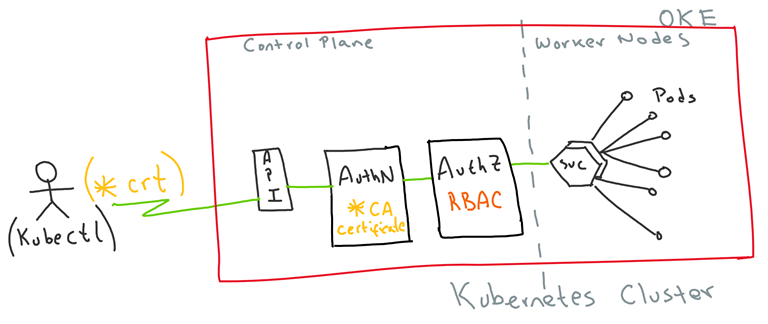
In a recent blog, I explained how to approve in Kubernetes external certificate signing requests from end users. This way, users can then simply use their private keys to authenticate into Kubernetes API server. Further to this, Role Based Access Control (RBAC) can be put in place to authorise access to resources in kubernetes clusters. This is amazing and provides some level of governance, however there is a caveat, since kubernetes does not hold neither users nor groups, the identities must exist outside the cluster somewhere else. If we create external CSRs with non-existent users and groups, soon it will become very hard to properly manage all the identities, especially if we have to maintain multiple users accessing the cluster. This is yet another area that gets highly simplified when Cloud vendors embrace kubernetes as first class citizens.
In this blog, I am going to show you how to create and manage your identities in OCI IAM and simply, using such identities to access Oracle Container Engine for Kubernetes (OKE) clusters and authorise access to resources.

In a nutshell, this is what I am going to do:
- Create a new user/group in OCI IAM
- Configure an OCI policy to grant access to my user’s group to access the OKE clusters
- Create Roles and Role Bindings (RBAC) in OKE to authorise our user to access OKE resources
- Download a kubeconfig set for my new user using token validation
- Use kubectl to access only granted resources.
Ok, let’s have fun!!!
Continue reading “OCI – Oracle Container Engine for Kubernetes (OKE) – Using RBAC with IAM”

 In November 2018, I had the privilege to attend the Australian Oracle User Group national conference “#AUSOUG Connect” in Melbourne. My role was to have video interviews with as many of the speakers and exhibitors at the conference. Overall, 10 interviews over the course of the day, 90 mins of real footage, 34 short clips to share and plenty of hours reviewing and post-editing to capture the best parts.
 RedThunder.Blog