This is my 14th #DaysOfArm article that tracks some of the experiences that I’ve had so far. And just to recap from the first post (here) on June 12 2021.
It’s been just over 2 weeks since the launch of Ampere Arm deployed in Oracle Cloud Infrastructure (OCI). Check this article out to learn more (here). And it’s been about one week since I started looking into the new architecture and deployment, since I started provisioning the VM.Standard.A1.Flex Compute Shape on OCI and since I started migrating a specific application that has many different variations to it to test it all out.
This is my next learning where I’ve deployed successfully openrouteservice – an open-source routing / direction API all deployed on an 4 OCPU with 24 GB of RAM in an Always Free Tier tenancy.
This is my 13th #DaysOfArm article that tracks some of the experiences that I’ve had so far. And just to recap from the first post (here) on June 12 2021.
It’s been just over 2 weeks since the launch of Ampere Arm deployed in Oracle Cloud Infrastructure (OCI). Check this article out to learn more (here). And it’s been about one week since I started looking into the new architecture and deployment, since I started provisioning the VM.Standard.A1.Flex Compute Shape on OCI and since I started migrating a specific application that has many different variations to it to test it all out.
This is my next learning is another retrospective with the OCI Arcade deployment the full stack is now being deployed on 1 OCPU with 6 GB of RAM in an Always Free Tier tenancy.
This is my 12th #DaysOfArm article that tracks some of the experiences that I’ve had so far. And just to recap from the first post (here) on June 12 2021.
It’s been just over 2 weeks since the launch of Ampere Arm deployed in Oracle Cloud Infrastructure (OCI). Check this article out to learn more (here). And it’s been about one week since I started looking into the new architecture and deployment, since I started provisioning the VM.Standard.A1.Flex Compute Shape on OCI and since I started migrating a specific application that has many different variations to it to test it all out.
This is my next learning where I’ve deployed successfully Pelias – an open-source geocode API all deployed on an 4 OCPU with 24 GB of RAM in an Always Free Tier tenancy.
(Update – 11th Oct 2021 – there’s been some changes made as this is a working document … as some of the packages have changed as well as additional fixes to make it easier …)
(Update – 28th Dec 2022 – I’ve refreshed the instructions for this blog post to match what is happening with Pelias as there’s been some cool changes to support arm64).
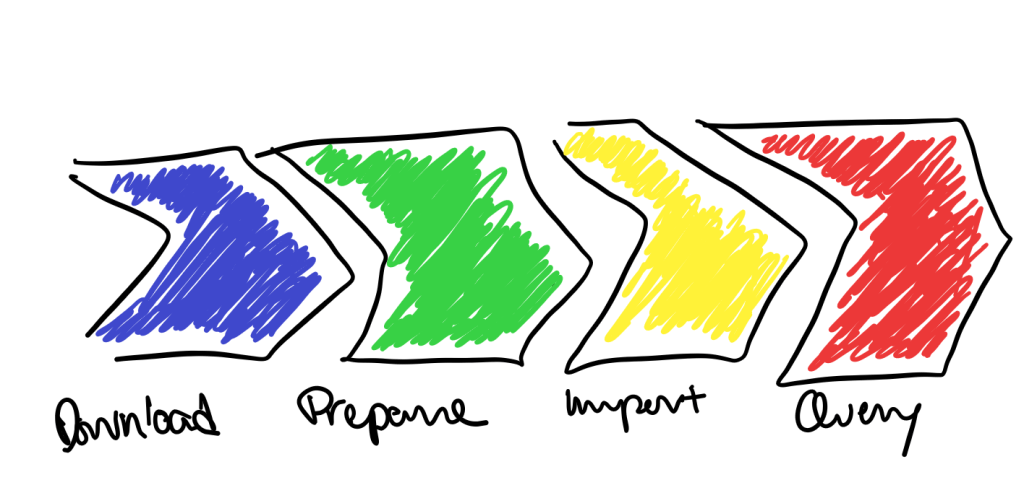
With the work that I’ve been doing with Open Street Map (here), I’ve been provisioning Pelias (here) – an open-source implementation of geocoding. This architecture is not small (consisting of 10+ docker images, and potentially 100+GB of raw geo data) especially if you are looking to geocode the whole world. The workload (or pipeline) had 4 main stages – download, prepare, import and query.
Download – to get the raw data sources
Prepare – to get the raw data into a format that can be easily imported
Import – to import the data into the elastic search (which is the backend)
Query – to accept geocode queries
Each of these stages have different performance characteristics and required different resources. The main thing that I’m looking at here is the use of compute. The need for compute during the prepare and import stages is significantly different from the download and query stages. I’m also not confidently in terms of when or how much I need.
And this is why I configured a burstable instance.
Here’s a couple of things to know …
There is a baseline utilisation OCPU. Consider this as a the minimum compute you want. For my scenario, it was primarily how much compute that I needed for the download and query stages.
There is full utilisation OCPU. Where this is can be 2x or 8x the baseline utilisation. (in the terms of the documentation – the baseline utilisation can be either 12.5% or 50% of the full utilisation OCPU). For my scenario, it was primarily the prepare and import stages that needed the additional compute.
The increased capacity is based upon the CPU utilisation metrics to determine whether to burst.
The average CPU utilisation for the month needs to up to the baseline utilisation OCPU.
Burstable Instances billing is known. It doesn’t come with Bill Shock.
You can find out more about Oracle Cloud Infrastructure burstable instances (here). If you want to try this out yourself or work on your own application, sign-up (here) for the free Oracle Cloud Trial. I’d be interested to hear your experiences and learn from others as well. Leave a comment or contact me at jason.lowe@oracle.com if you want to collaborate.
Recently, Oracle rolled out the OCI Bastions service, which is designed to simplify the process of accessing instances which do not have a public IP address. They are really easy to use, with simple commands to allow access to these internal hosts… if you are using a Unix shell. Unfortunately I suffer from being quite wedded to various tools, and as a Windows user, I tend to use PuTTY to access hosts via SSH, so this blog post will detail both the OCI Bastion service in a little more detail, as well as how I continued to resist changing my old habits, and set up connections using the OCI Bastion service using a number of components of the PuTTY suite of tools.
Over the weekend, I took some inspiration from a few different sources and put this together in action. Taking what Todd Sharp has mentioned on his blog (here) and what I’ve been doing with my #DaysOfArm article series (most recently here) and some of the things that I’ve been doing at home with learning how to code – then this is what’s been able to be achieved and some learnings and differences that I’ve taken with running Minecraft (on Arm).
There’s been numerous announcements about Oracle Cloud Infrastructure (OCI) adding Arm-based Compute to the list of Virtual Machine (VM) Shapes. Check some of the announcements (here) and (here).
You can also watch it (here) too with Clay Magouyrk, Executive Vice President, Oracle Cloud Infrastructure. Note: The link above has more content and videos.
Have you seen the OCI Arcade? We have built the architecture deployable on OCI Always Free Tier.
Recently in the OCI Always Free Tier, an additional services has been added to include 4 cores and 24 GB of RAM of Ampere A1 Compute. With this additional capacity, it made sense for OCI Arcade to be ported to this A1 Compute Shape. Here is what we did and why.
The new platform will provide OCI native integration to provide operational insights into our OCI services in addition to previous capabilities available in Oracle Management Cloud. Logging Analytics is the first major Oracle Management Cloud Service to be incorporated, and so my fellow colleague @callanhp and I were itching to give it a go and see how we could implement it, so we chose the most available logs we could think of, the audit logs from the OCI control plane.
In this blog we will discuss the mechanics for forwarding OCI Audit Logs to the Logging Analytics service from the Oracle Cloud Observability and Management platform, and discuss how this pattern can be extended to other log sources.
April 16-19 saw people from across the world come together to focus on three Sustainable Development Goals (SDGs) at the #WorldInnovationDay Hackathon. This blog highlights the technologies used to help accelerate the team’s execution. If you want to read more about the event itself – check out this previous blog (here).
Over the course of the weekend, Oracle Cloud tenancies with $500 USD credits were provided to each participant to use. It was not mandated that they use Oracle Cloud nor was it given to participants automatically. It was encouraging to see people open to explore and learn with Oracle Cloud. I want to thank the Oracle mentors supported the participants ensuring that whilst the teams explored, they could confidently execute and deliver. Here are the common requests from teams and the cloud services that they used over the weekend.
We are providing to each participant access to Oracle Cloud Infrastructure (OCI) for the hackathon. The following resources are to make you effective with OCI.
Oracle Cloud Infrastructure
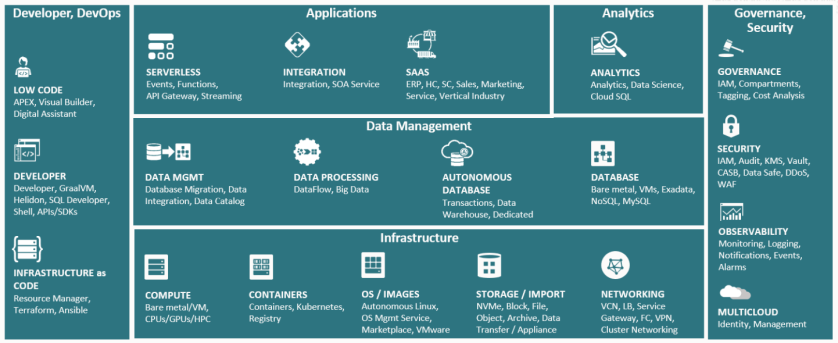
From past hackathons, we noticed a trend of what technologies and services are being used by the winning teams. Here are the top resources with some additional references.
For a single platform to store JSON, Graph & Spatial, perform ML or deliver Low-Code Apps, use Autonomous Database (here)
For establishing infrastructure with your OS of choice, use OCI Compute (here)
For Jupyter notebooks and ML packages, use Data Science Cloud (here)
For quick self-service and data visualisation, use Analytics Cloud (here)
For making sure everything is secured, use Oracle Security (here)
For most things you need for #AppDev, use Oracle AppDev (here)
Live Labs
You will need to learn quickly. These hands-on workshops will help you learn more about the services available.
For those who are interested in a single platform to store data (here)
There will be a series of workshops where we will be present on different OCI topics in the week leading up to the hackathon. Make sure you have these in your calendar so you don’t miss out.
And reach out on the #WorldInnovationDay Hack 2021 Slack workspace if you need anything from the team.





 RedThunder.Blog